Tag Archives: Susan L. Feller

A day reflecting and forecasting

Using this time of the year to review my artwork is misleading yet revealing. The full exploration is omitted. That is the body of work recording experiments, progress and preferences in techniques, materials and design. Yet the time capsule approach unconsciously exposes a compass-nature is my muse.

2013 I received a Fellowship from the Tamarack Foundation for the Arts to complete research on Blanche and Oltha McDonald, fiber craftsmen from Gilmer County WV. I also began a Year Study of daily designs exploring my collection of art/craft tools.

The Year Study came to a close 11-4-14 with a collection of 365+ works and several larger rugs. My work has not ended though, every piece I think about a lesson learned from the daily exercises.

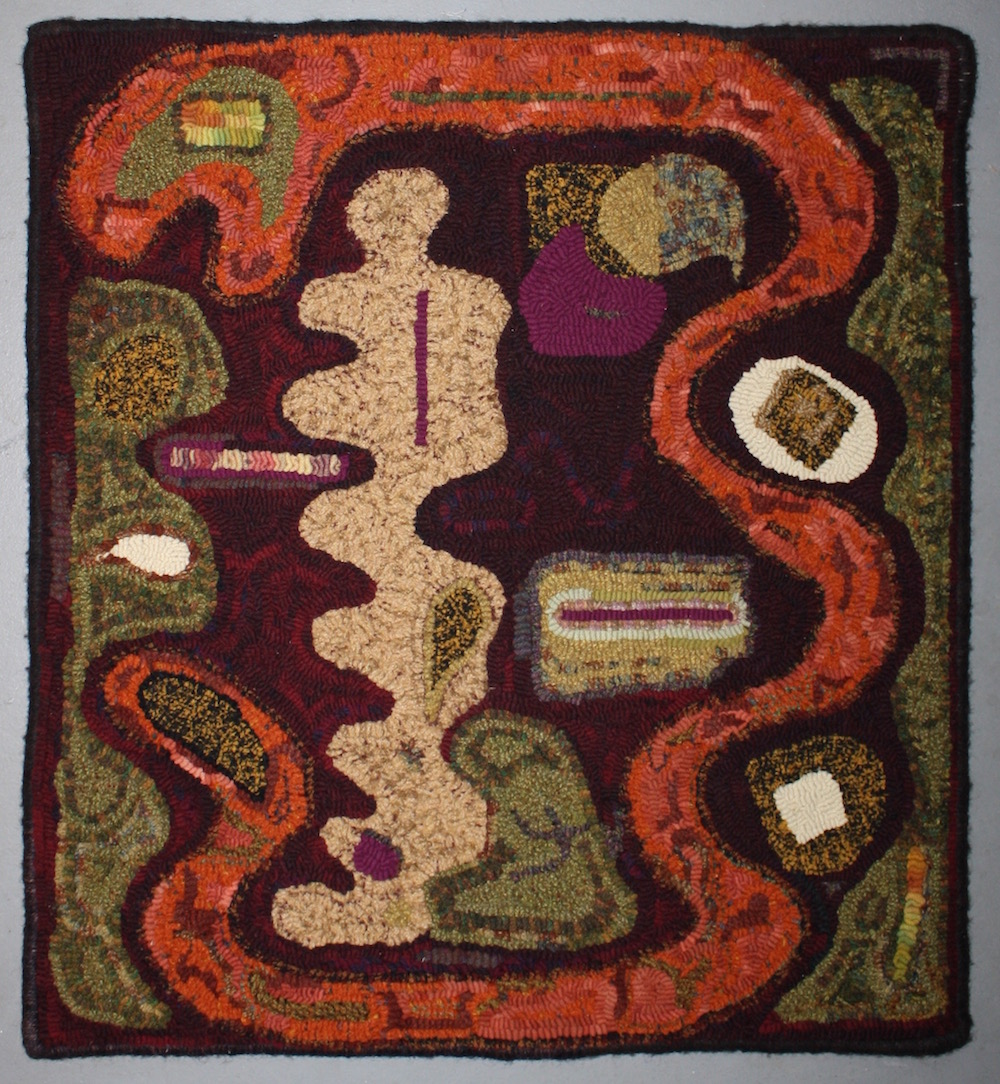
11-3 to 11-4 2014

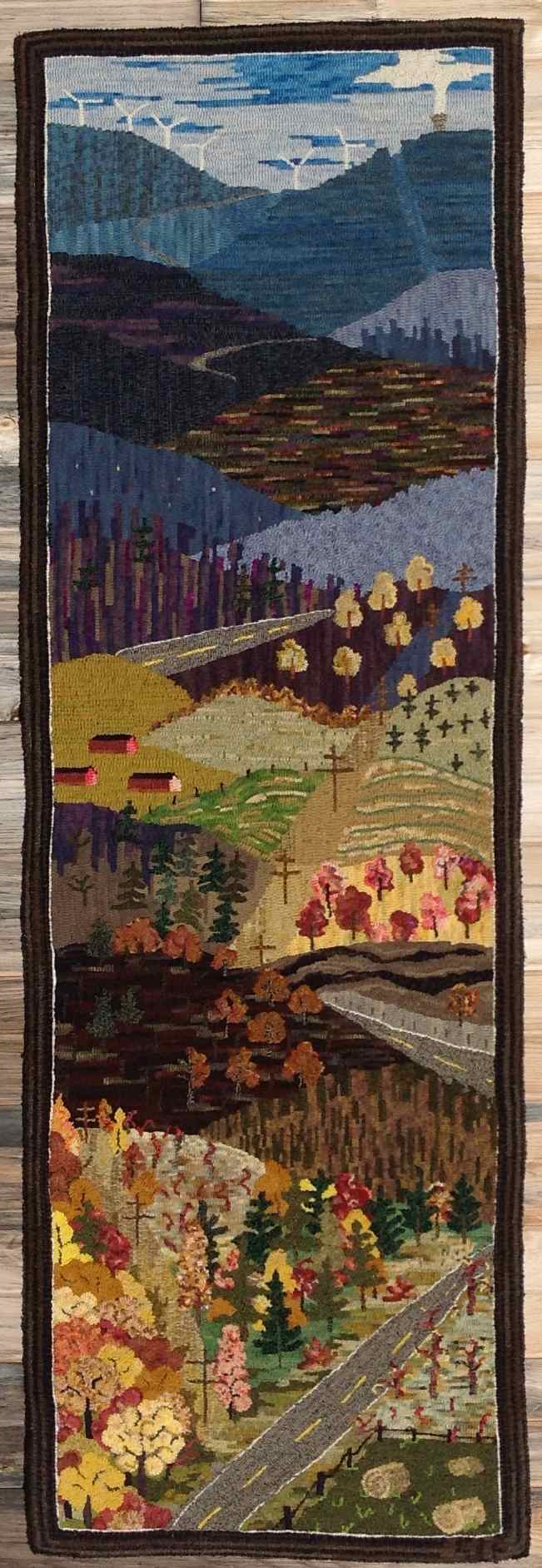
Progress in the Mountains, Susan L. Feller 2015


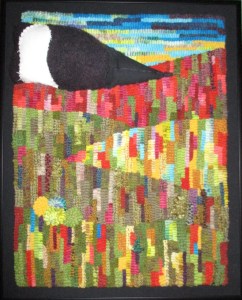
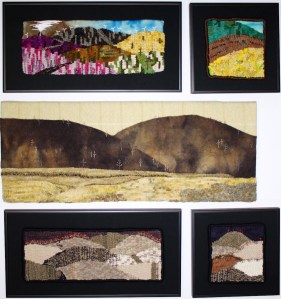
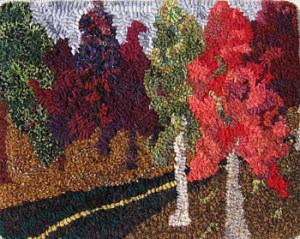
The natural beauty of West Virginia is valued by a variety of economies. It supports tourism, agriculture, transportation, energy and logging along with generations of living with and on the fruits and animals of the land. Progress in the Mountains was created to celebrate and acknowledge the real Wild and Wonderful of the Appalachians in 2015.


Along came 2016 and in the fall a big change.  My artwork began a period of talking. Craft is a therapy with tools of slow stitching, loop pulling and gratification of controlling the end results.

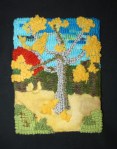
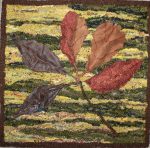
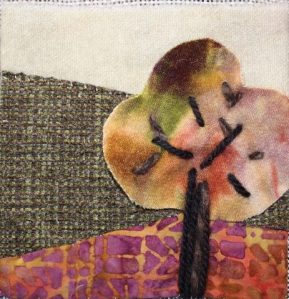
The therapy and a personal effort to become involved with my local community, sharing and listening to multi-generations, seems to have worked this year. I am back to reveling in telling the stories of our natural surroundings. The Leaf Series encapsulates the techniques, materials and design style of my life studies.

Another year is ahead.


A town hall with a Senator

On a different topic than artmaking, but relevant to my work since government attention to issues is refocusing and I am reacting to those actions by being informed.

I have not been in Civics class or Social Studies since 1973 but I attended a session today. Senator Joe Manchin was invited by the Hampshire High School DECA and Social Studies department to a town hall format presentation at the school. Since I am not involved with a family member in the school system, I would have missed this opportunity if we did not subscribe to the Senator’s October 24, 2017 newsletter which listed the event as a public affair. After verifying with the news staff at Hampshire Review (our local weekly media outlet) I decided to attend. He was coming barely 20 miles from my home after all.

Pulling onto the grounds of the school there were several students at the “check-in” station, I asked if I needed to verify purpose and was directed to the main office to sign-in. Come to find out the event was in the Auditorium accessed from the back parking area and no sign-in was necessary. The space filled with chatting students (some with breakfast in bags although a sign said no food or drink and I had not brought my coffee in recalling such restrictions in my youth). Some received a listing of the questions the class had agreed would be asked, to act as presenters during the session. The press was represented, Board of Education members, Commissioners, Economic Development Director, state official and school staff along with many fellow public citizens.

audience Hampshire High town hall with Senator Manchin

Just a few minutes after the 9:00 am scheduled start, the US and WV state flags were processed by FFA members, the Pledge of Allegiance said by the audience and the Senator was introduced by a Hampshire High Senior who holds office in a local and state organization.

I am going to say my reasons for attending were to confront the Senator with an issue about rescinding the clean power plan guidelines and listen for comments which I could interpret as not representing the progressive, open United States I picture for 2017 (a defensive attitude). I realized at the end of the hour and half that there is a place in our lives for encouragement, support, acceptance, and assistance not divided by party affiliation, economic or social status and certainly not divided by religious beliefs or media bias. The social internet rabbit hole that sucks so many down with emotional buttons and quick captions is not LIFE. Conversation and compromising to achieve change is better than bickering.

Senator Manchin knew the profile of his audience and spoke with encouragement, challenges and lessons for the juniors and seniors just starting out in the world and hit home to even this “senior”. He related stories from high school days as a football player and visiting Romney four years staying with two families who he continues to keep in touch with. How an injury in college changed the path of a football career and having to knuckle down and study for his degree.

The student’s questions ranged from asking how and why he entered politics…he wanted to help beyond his own community. What does he like and dislike about being a Senator? The responsibility to be part of helping WV, the US and realizing those actions reverberate around the world is an honor; negative – the politics of saying the other side is wrong because they are the “other side”.
What can be done about poverty? Federal government has fought “the war on poverty” since President Johnson, but are we giving money out or training/educating people for the skills needed in jobs today? In the 1930’s President Roosevelt instituted the Rural Electrification Act and everyone got electricity. Now in 2017 Manchin has discussed with the President the need for Rural Connectivity….updating the internet access in our state and many others to equalize the opportunity for broader education, business, communication while staying in our communities.
The opioid epidemic needs to be funded and addressed as an illness, not a felony. More treatment centers, education of medical personnel to not prescribe as easily, and a minimal tax on each pill made paid by pharmaceuticals to fund these avenues should be parts of the program the President has recently announced.

The wall, the 2nd Amendment, health care, medicare, arts funding, environment, LGBTQ acceptance were all topics explained, or at least addressed in a courteous question and answer format.

Senator Manchin’s overall message was a pep talk to the students: You live in a country that allows you to do whatever you want. You just need to decide what that is, figure out how to achieve it with finances, education, opportunity and act. Nothing should be a barrier, inviting students to contact his office for guidance. The students must be educated, clean (of drugs), and prepared to enter the next phase of life. Every child should expect five elements: a person to trust, a support system, a safe place, to develop skills, and then to give back to others. We all can think of how to fill these needs for children/people in our community.

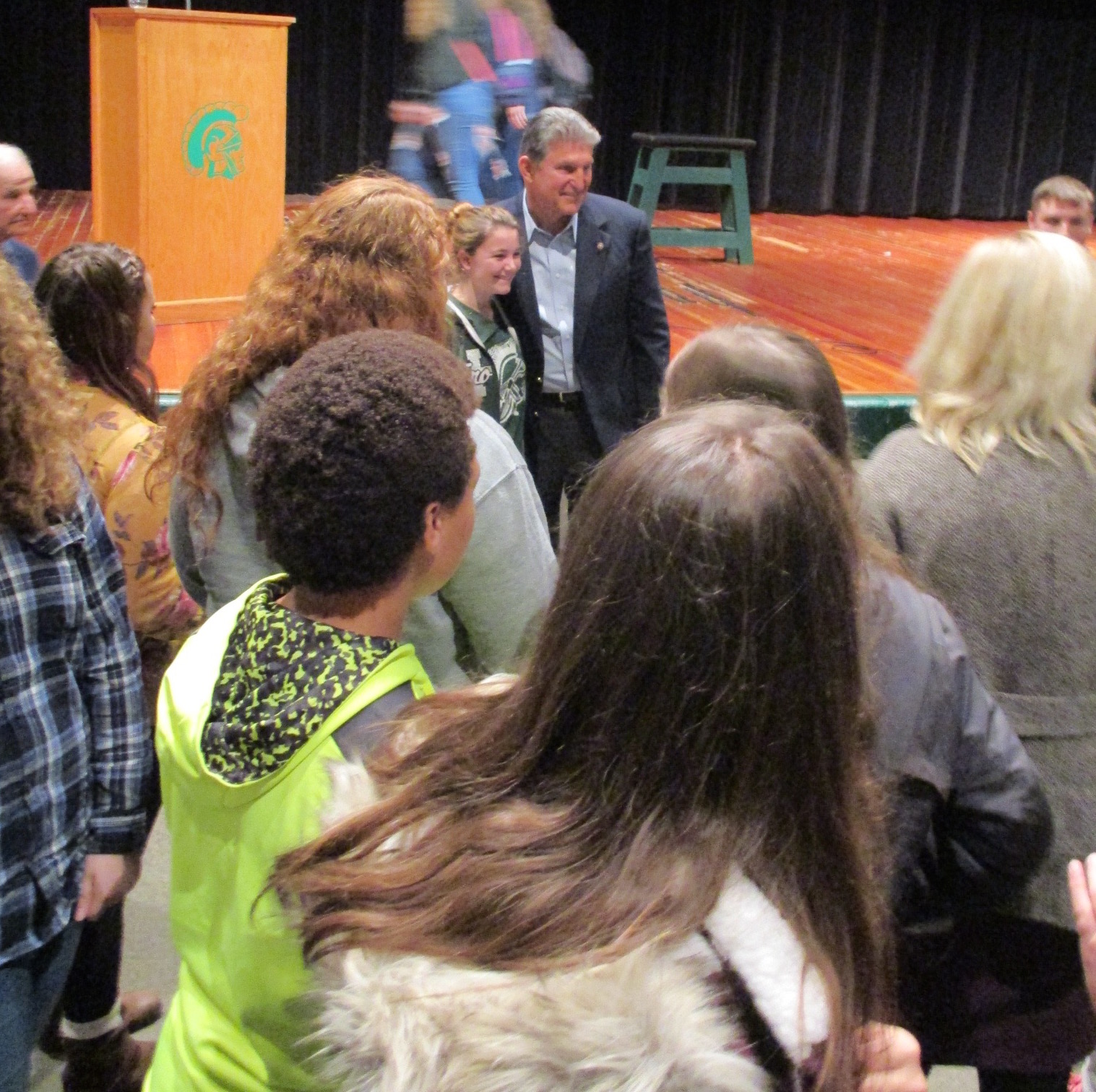
photo session with Senator Manchin

I left energized, actually emotional as I recalled the exciting challenging debates in my Social Studies class those many years ago, and optimistic that the next generation of Hampshire High students will contribute to their community near and far. I hope you meet some of them along the way.

SaveSave

SaveSave

Exhibiting near home

Jennifer Lockwood and Susan after hanging show

There is an arts community evolving at The River House in Capon Bridge, Hampshire County, WV. Monthly art exhibits feature one artist or a theme, September it is me! Meet and greet Friday Sept 1 4:30-5:30 followed by an open mic night. Fiber art is on display Thursday-Sundays through Sept 24 which is Capon Bridge’s Founder’s Day celebration also. Food, classes in art, music, craft, food, general living skills are conducted by members of the community. Come visit, we are one county into WV just west of Winchester, VA and 2 1/2 hours from Washington, DC on RT50W.

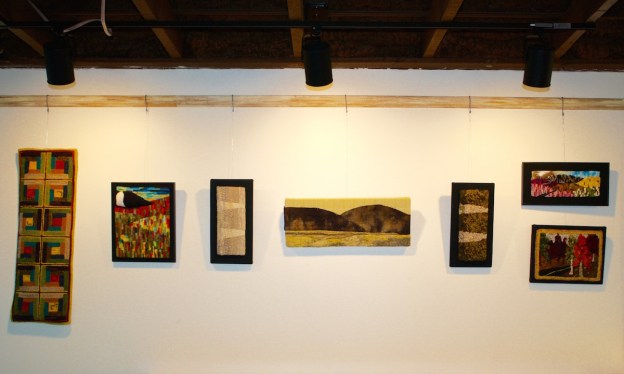
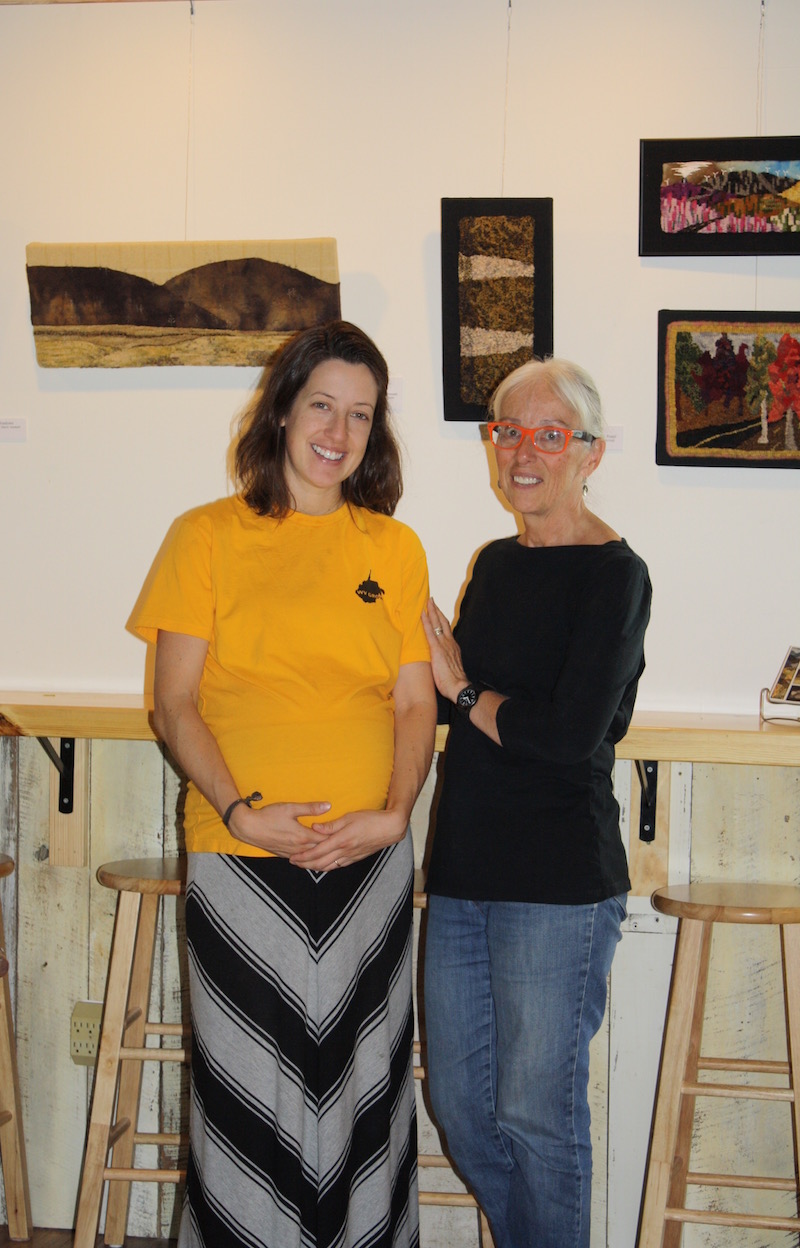
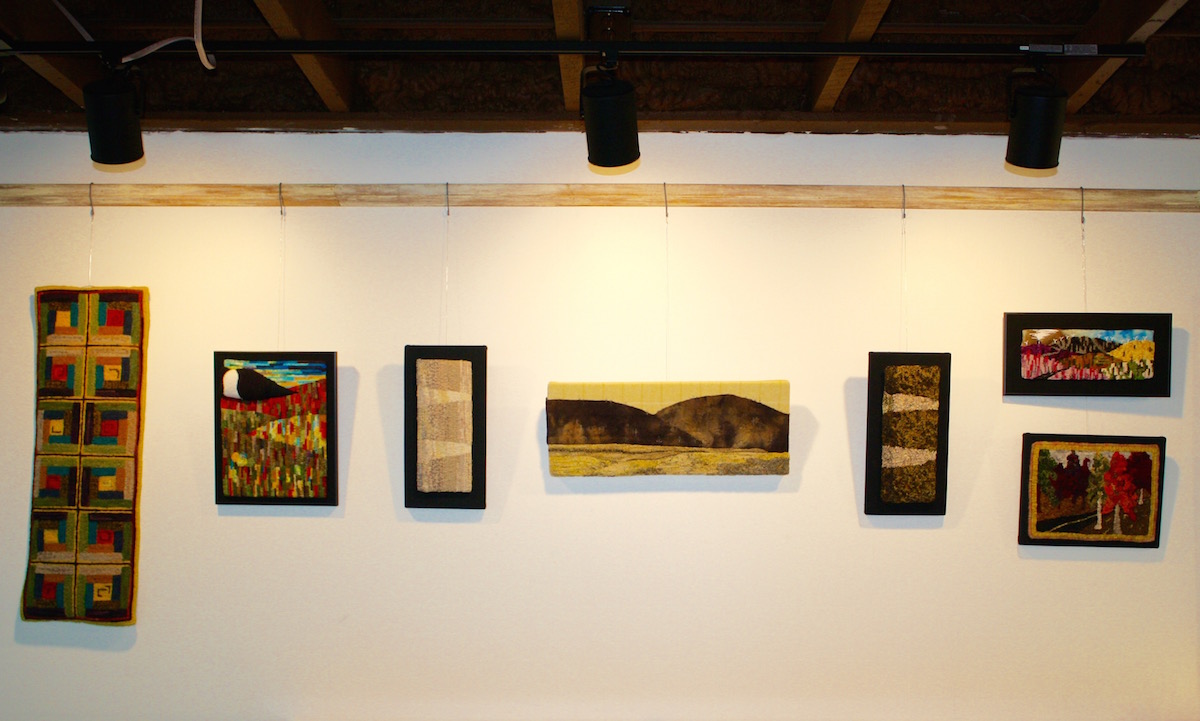
Track lights and a hanging system on white walls creates a gallery display for cafe goers and entertainment audiences as they listen/participate in staged shows.

I actually hung two shows, focusing on one theme for each display wall. What will catch the eye of visitors first I titled    “Observing while traveling through…”

mixed textile pieces depicting nature

The natural wonder of West Virginia is affected by humans exploring, encroaching and expecting the resources to make them happy. Voices both vocally and visually are used to bring awareness to the fragile environment. The latter method to communicate is my preference, believing the image of even a tourist’s visit captured using traditional crafts will encourage awareness and protection for the future.I encourage you to view my art for the moment of beauty I captured and shared with you.

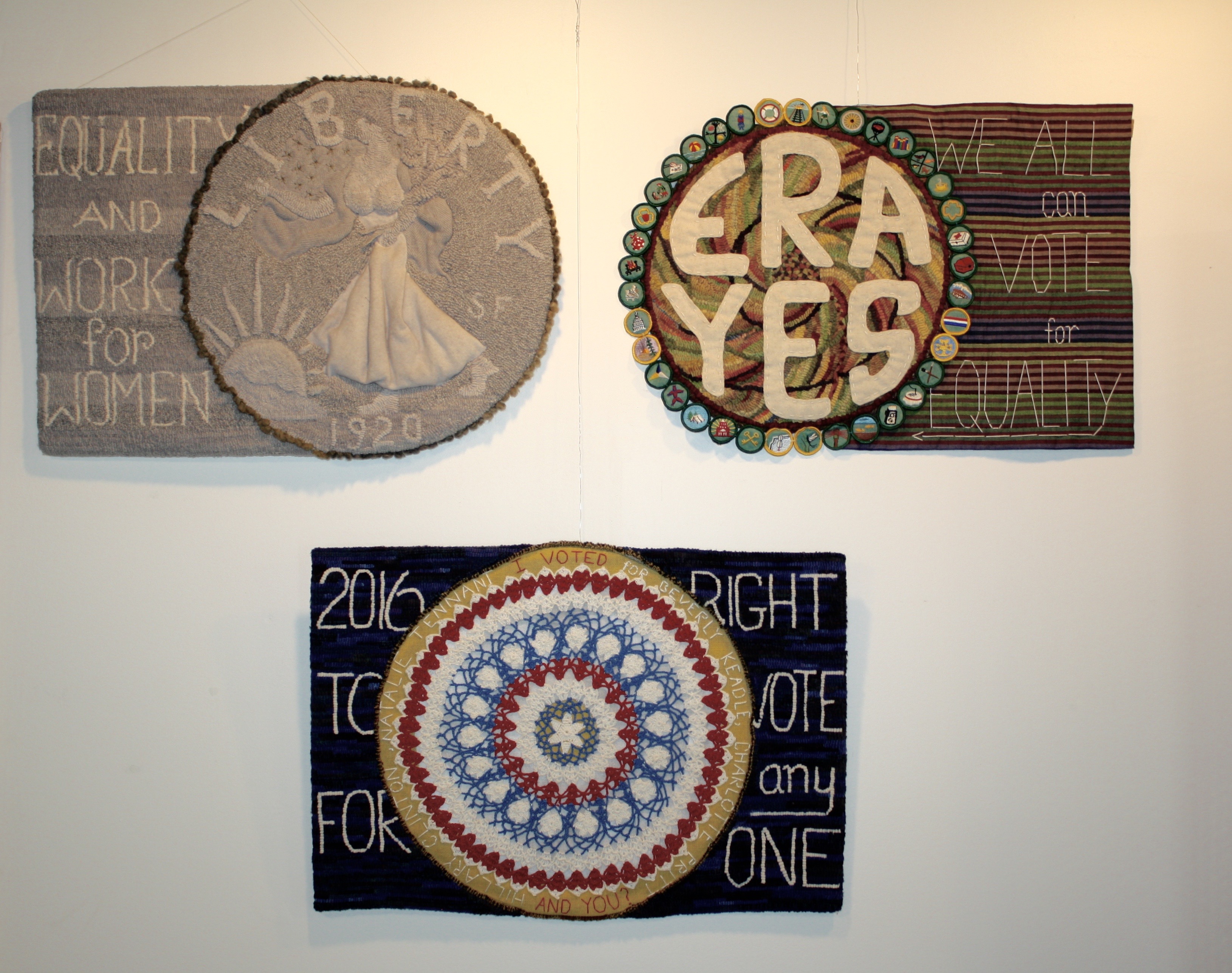
The opposite wall presents the Iconic Series created over fifteen years.

Liberty, ERA, Voting by Susan L Feller

The pieces chronicle three generations of women. My grandmother came of age in the 1920’s working and supporting herself prior to marriage. That marital relationship from the stories I heard and witnessed was one of equal responsibilities as entrepreneurs. Iconic Liberty and women’s right to vote in 1920 symbolizes her powerful self-esteem.
My mother again worked before marrying going back to work when we were in grammar school because she had administrative skills to share. Volunteering as a Girl Scout leader her encouragement and example kept me involved through high school. The early 1970’s environmental awareness and the quest for establishment of the Equal Rights Amendment are represented by Iconic ERA. (A line from each yellow badge set to the center forms the PEACE symbol.)
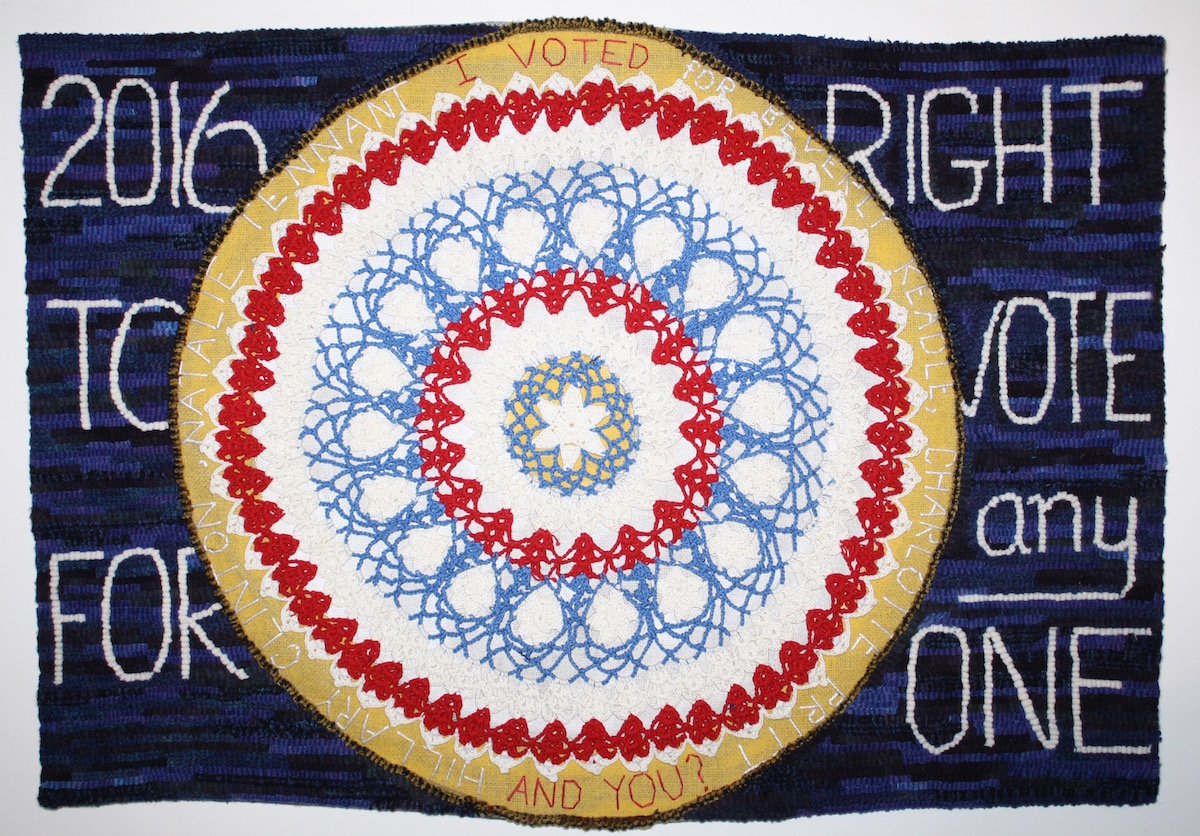
I was raised to question, research and vote for candidates and principles I believe will benefit the community, country and global elements. Iconic Rights captures the 2016 election with an important message: “I voted…and You?”
The circle in each design is an ancient symbol for life. I used it because our lives are part of a continuum. We all have contributed.

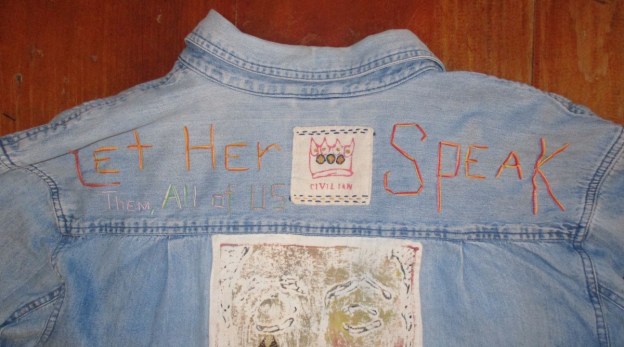
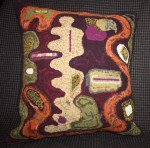
There are four small pillows with hooked fronts and embroidered backs bringing attention to contemporary issues: Gender, Climate, Rights, and Persisting. Generations of artists used traditional crafts to communicate: reflecting, documenting events, opinions and the spoken word.

Perhaps it is my comfort with age, a realization that my voice is heard, or a confidence that others can be encouraged to think; whatever drives me the making of this body of work is cathartic.

It will be interesting to talk with visitors Friday and through the month sharing techniques, approaches to subject and issues raised by these visual objects. Except for the Iconic Series the works are for sale. There are also several images made into notecards. Can’t visit in person shop online at my store.

Mountaineers talk about Passion-Rughooking

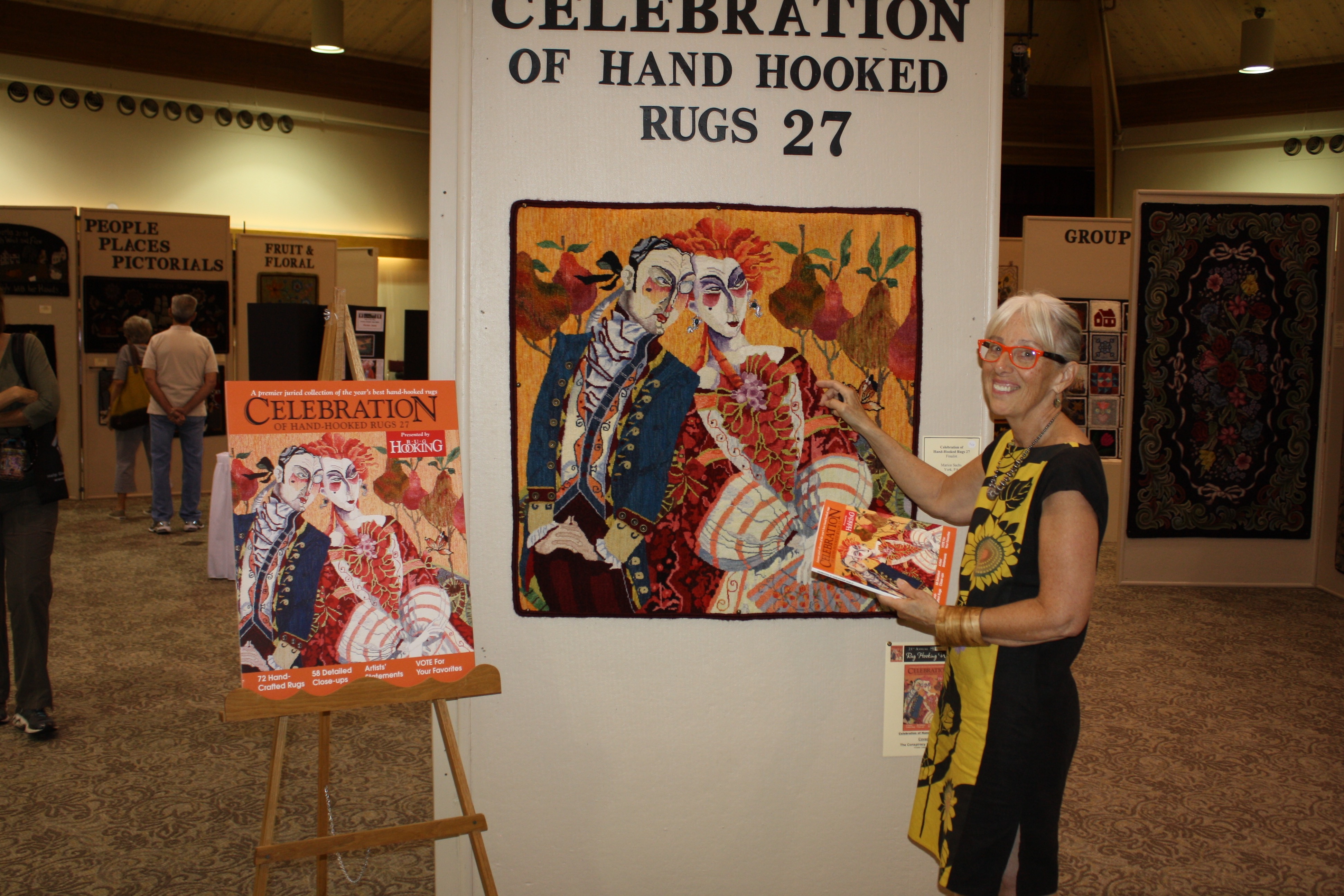
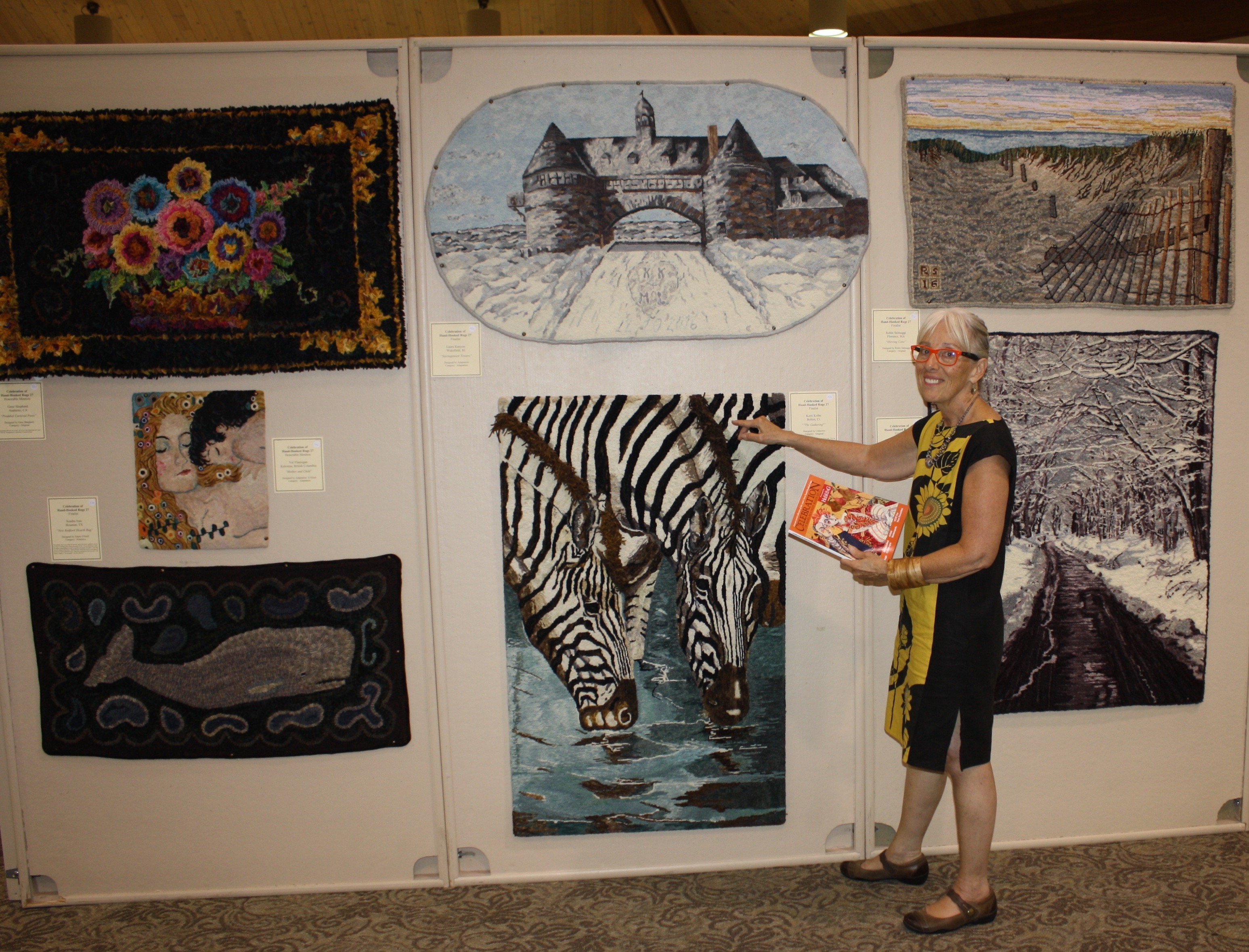
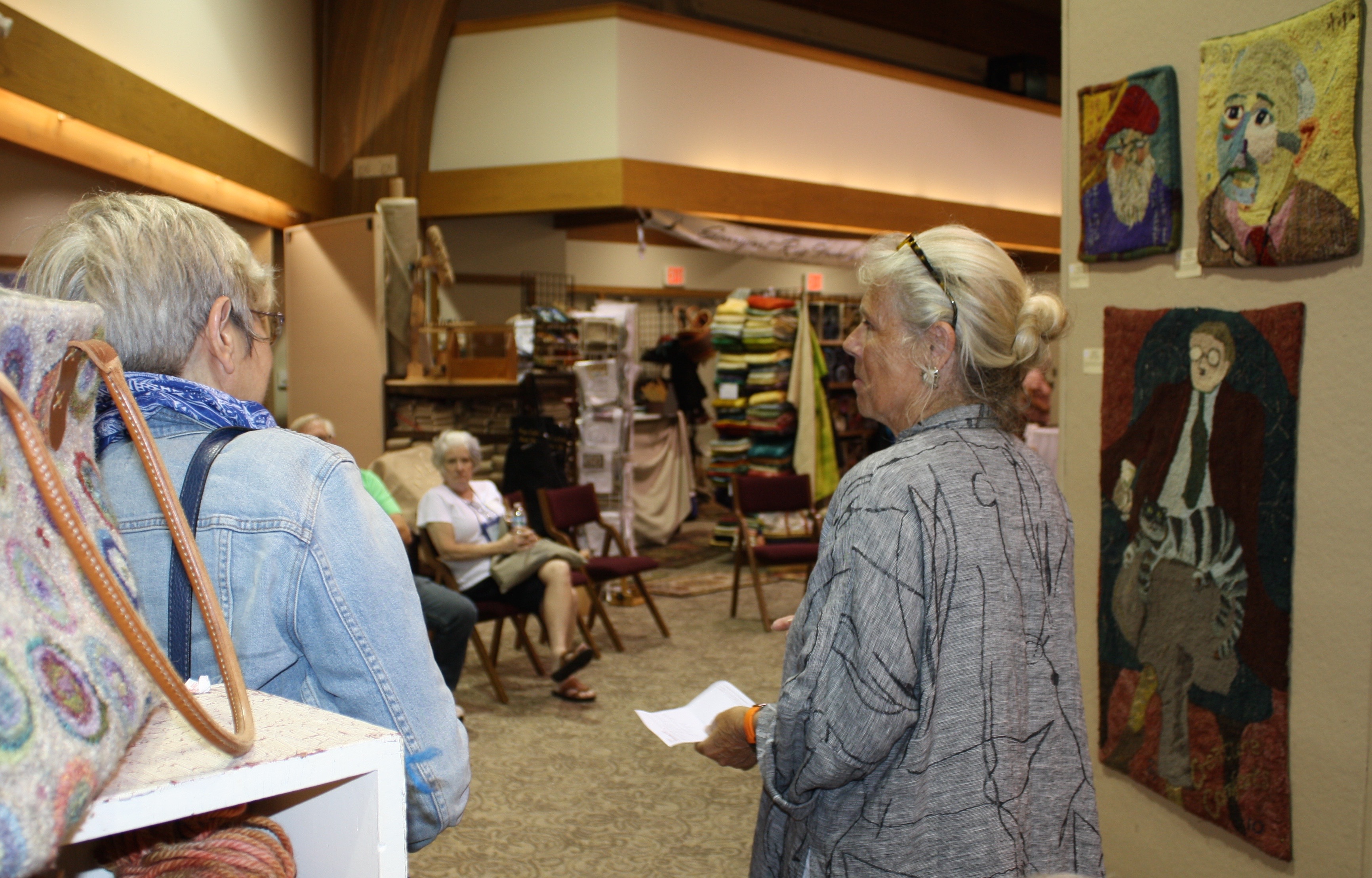
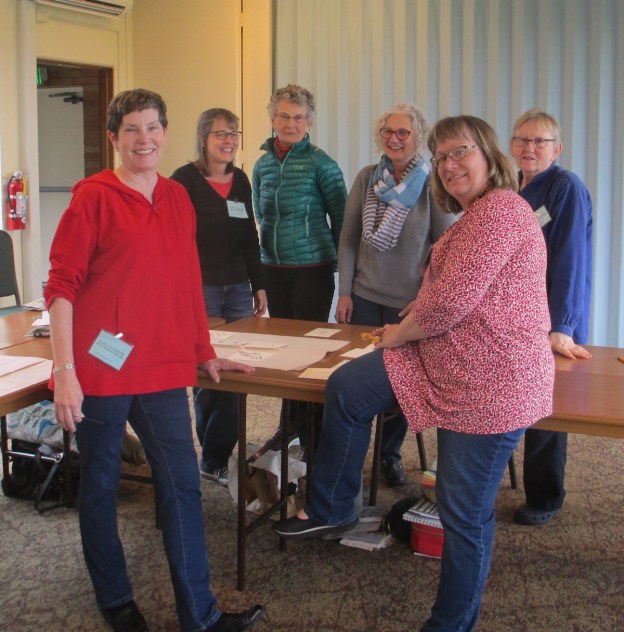
Susan Feller and June Myles presented gallery talks at Sauder Village Rug Hooking Week. As West Virginians each appreciate the heritage involved in rughooking and have been featured in WV Living Magazine with their work.
Discussing Marion Sachs’ interpretation of David Galchutt’s art

The topic of Susan’s talk was pointing out the elements and principles of design in the winning entries for Celebrations 27, published by Rug Hooking Magazine. She has been included in three Celebration of Hand-Hooked Rugs issues and a judge, her work has been juried into several contemporary Hooked Art collections. Author of Design Basics for Rug Hookers, Stackpole Books 2011, her advice has helped many create their own “Great rug.” Involved in promoting the traditions carried on by artistic contemporaries, Susan teaches and lectures worldwide, and is a member of TIGHR, McGown and Surface Design.


hooked with wool fabric or yarn juried work. Celebrations 27

June on right during talk

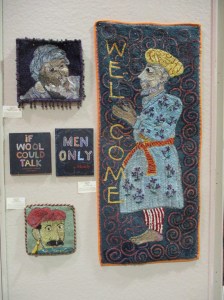
June has been hooking since 1988. She is a graduate of Hollins University in Virginia with a degree in physics, and spent her junior year abroad at the Sorbonne in Paris. She has maintained her interest in science as well as art, serving for three decades as a docent at the American Museum of Natural History. She is the artist and author of the Men Only book and hooked rug collection. The stories June shared about how she selected a newspaper clipping saved for decades, or woodblock from children’s book as subject were encouraging to the audience as resources. She described the variety of materials and techniques used to finish the edges from old chestnut frame by a friendly carpenter to the right beads accenting an Afghanistan fellow.

Attendees said participating in the gallery talks at Sauder Village adds to the learning process for the full exhibit. We encourage you all to take advantage of a docent lead discussion on your next museum visit.

Spring and nature’s marks

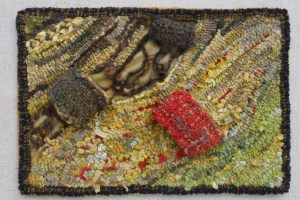
Winter weather has been good for working in the studio. Old techniques from my teens were at the center (literally in the circle hoop). I even got out in the community for a women’s group reading. All of these projects are different avenues for me but necessary in my growth. Cards depicting two of the pieces are in the shop now.

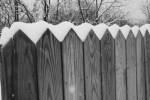
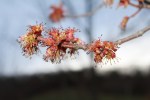
Spring arrived on the calendar, on the air with the sounds of migrating birds returning to establish territories, and on the branches of our trees. I like to follow these changes daily with camera and my eyes developing new designs. The slow stitching I explored through the winter and prep for abstract expressionism workshops have me looking at lines/marks within fields/shapes of color/value.   In the grouping below the snow on fence and maple flowers compositions interest me most. Will see how I interpret them.

Hope your creative juices are flowing too.

Have you been to San Francisco?

I have and the experience is inspiring. Lines, light, shapes in buildings that remind me of trees, trees with different shapes, wide roads filled with cars and narrow ones surrounded by vineyards and GREEN. It rained and nature is responding with color and profusion.

Water and travel to places means bridges. I have made it across the Golden Gate Bridge and into Wine Country. Hills that are rounded but tall, rolling hills filled with the skeletons of spring vines, a rocky coastline and broiling waves are images I can conjure up from the past few days in Sebastopol and now Walnut Creek outside of San Francisco.

I was 3000 miles from home teaching an eager group mixed media techniques to incorporate into their rughooking designs. We explored the elements and principles of design, experimented with materials and techniques and shared ways we process, design and see. Here are some works in progress. The full class of 15 promised to send photos when completed. The workshop was sponsored by the Wine Country Rug Hookers an ATHA chapter. My compliments to everyone involved in setting up my contract, travel, definitely the evening dinners and enthusiastic participants.

Finishing work 17 years later

I learned an artistic textile technique, rughooking, in 1994 and stepped into the pattern making (line drawings) by interpreting traditional folk motifs on frakturs. In other words using someone else’s visual design (centuries old and out of copyright infringement) and composing with an expected balance. I mastered skills, materials and tools and became proficient in the craft.

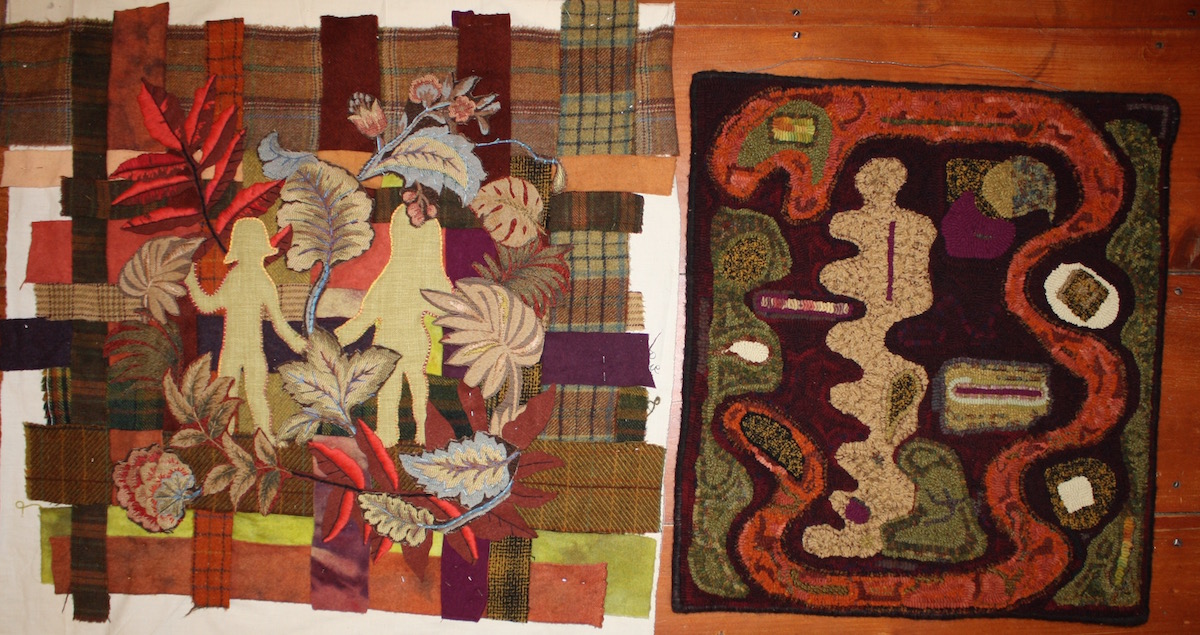
Adam and Eve, Susan L Feller 2000

Adam and Eve, Susan L Feller 2000

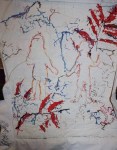
By 1999 I wanted to grow into my own style and enrolled in a workshop “Balancing Act” lead by Rae Harrell at Green Mountain Rug Hooking Guild in Shelburne, VT. With an open mind and no planning lines were directly drawn on the foundation material, my colors selected from a comfort pile and friends contributions, and I began to hook breaking “rules” I did not even know I had adhered to when I saw others using different widths of strips in one piece! The result was Adam and Eve, completed in 2000 and juried by Mary Sheppard Burton into an exhibit Hooked Art in the 21st Century at the Textile Center, Minneapolis, MN.

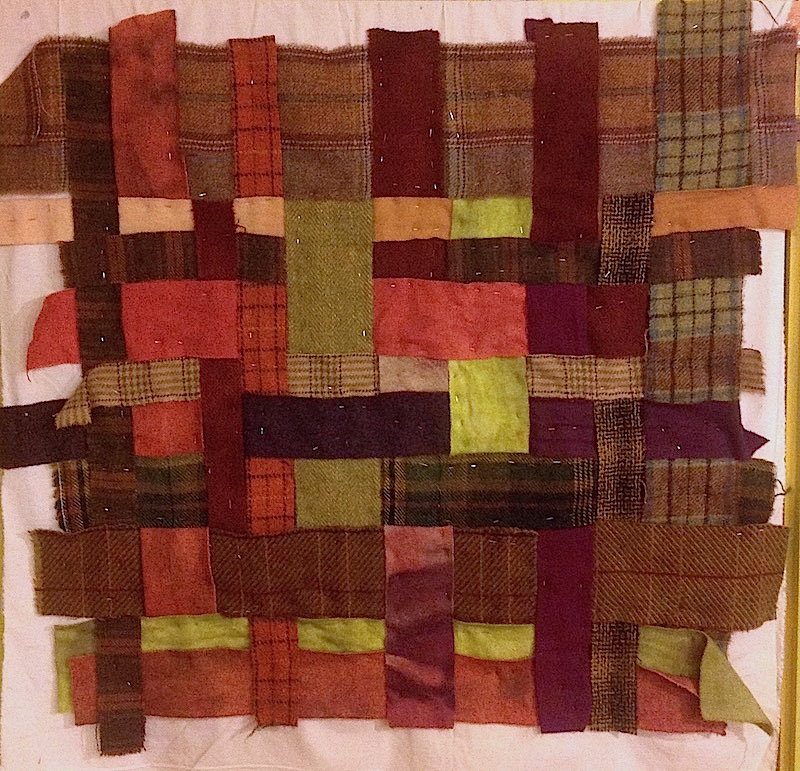
I have continued this journey making patterns and more regularly creating artwork depicting the natural wonder around me in West Virginia, and communicating social and economic issues. All the while a panel hung in the studio labeled “work in progress-Adam and Eve weave”.

base, woven wool from Adam and Eve, Susan L Feller 2000-2016

base, woven wool from Adam and Eve, Susan L Feller 2000-2016

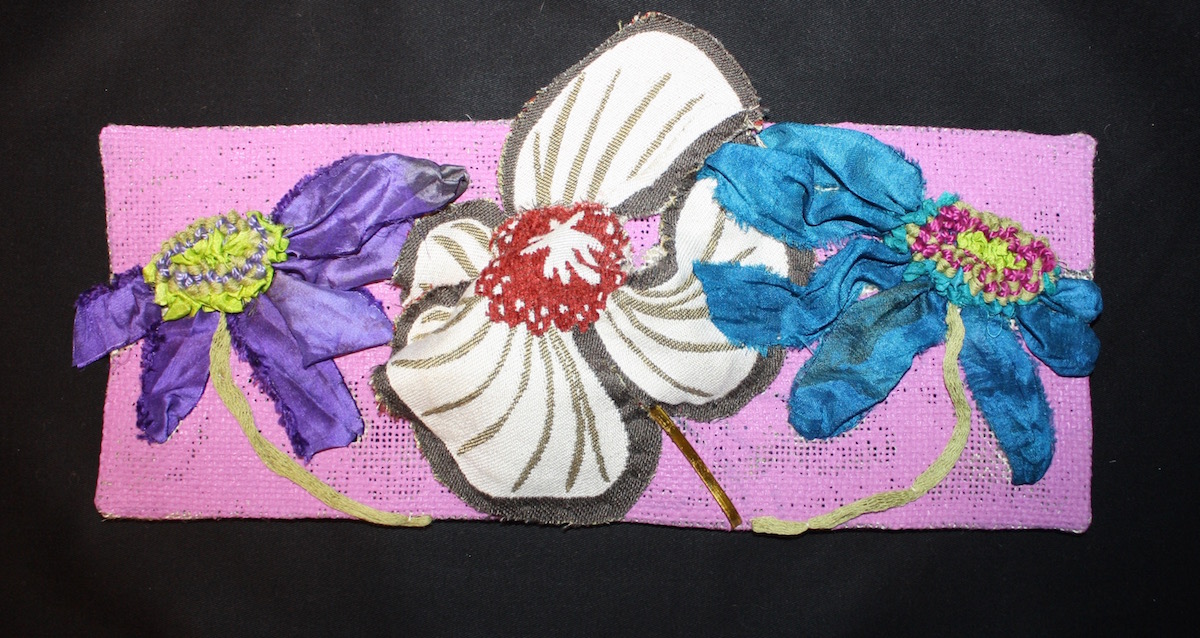
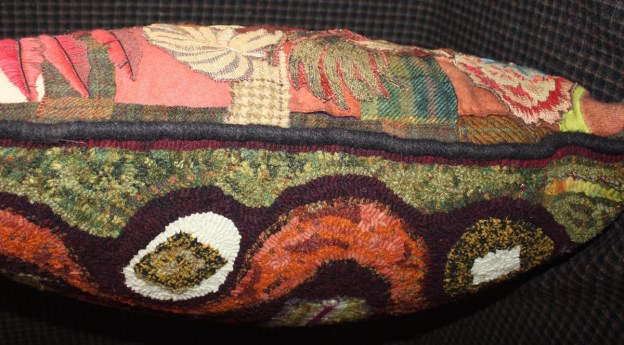
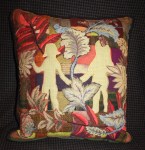
I had pinned onto muslin strips of the fabrics used to hook Adam and Eve with intentions to stabilize them either subtly or with embroidery stitches and attach to the hooked piece creating a large pillow (22 x 24).  A year of exploring past and new skills (Year Study), five years researching textile craftsmen from West Virginia (McDonalds), a source for discontinued upholstery samples and a conscious pull back to slow stitching with thrums from weaver Wendy Clark I finally felt it was the right time.

I enjoy composing, selecting materials and techniques each step interacting with the others until work can begin. There is a point of frustration when an idea can not be accomplished with existing materials or skills ….. the hunt for those takes away from the creative process but is essential if the work is going to be great instead of just good. I always have too many ingredients and need to simplify too.

upholstery samples, motifs from Design in a Box-Frakturs, Susan L Feller

upholstery samples, motifs from Design in a Box-Frakturs, Susan L Feller

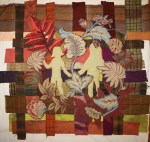
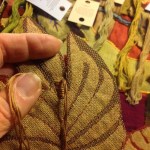
The two figures came out of my Design in a Box-Frakturs. Until the organic leaf with blue color upholstery was added, my design was ok but too equal in values, shapes and colors. I decided the figures did not need to have facial details for us to know who they were. By us looking at their backs and the plants layered over the bodies the title made sense. They are going into the garden where the serpent rises up on the hooked side.

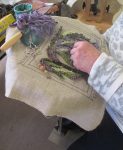
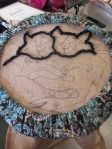
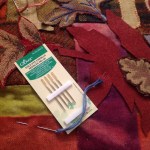
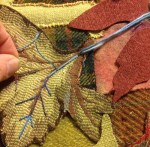
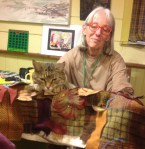
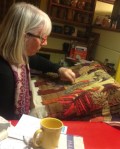
The tools needed were simple: embroidery needle, threads, sharp scissors, and a few embroidery stitches from my past (satin, long and short, and back stitching) with my studio frame by Townsend Industries and Bob the supervising cat. By stretching the piece on a 14″ square frame I often used the left hand as precisely as my dominant right one. I involved people in the process using Instagram and Facebook postings (the images show my left hand holding tools often staged for the shot).

Construction problems needed to be solved: selecting and installing a zipper (pillow form needs to be pulled out for transporting shell to workshops), anchoring edge with layers of wool and muslin and eliminating bulk for pillow, hand stitching two together when one was slightly larger than the other (measured but design grew, wool is a flexible material) but it all came together on January 16, 2017.

Into the Garden, Adam and Eve

Into the Garden, Adam and Eve

The proverbial question asked of a craftsman “How long did it take you?” can be answered this time with “Seventeen years!”


2016’s influence

It’s time to look back, review, evaluate and gather inspiration from the people, places and things on my journey of 2016.

With students and friends while gathering for a few days of immersion in our mutual interests…fiber arts on the Puget Sound, retreating in Hampshire County WV and South Carolina, teaching in Maryland and Ohio at Sauder Village and lectures at Schwenkfelder Library, Pennsburg PA inspired me as much as my encouraging their design skills. Working with Alissa Novoselick and Emma Pepper developing an arts conference in WV; participating in an exhibit curated by Roslyn Logsdon in Maryland; promoting the McDonald Sisters of Gilmer County to thousands; and handing off a legacy to Green Mountain Hooked Rugs exposed me to new skills and supportive people.

Big city Seattle, arts filled Asheville, rural Summerville Georgia,  Thomas, WV population 600 and the beauty of nature along trails in Fayetteville, Seneca Rocks, and Harpers Ferry are places remembered in my sketch books and beginning to appear in fibers.

We gather objects to remember places and people especially collecting them from fellow artists. I like to wear jewelry made by artist friends when traveling, it is as much of an ambassador as I am. We often photograph our flowers in the art vases, new artwork hanging on log walls, and even show great food on our trips sharing our experiences with an “extended family”. Thank you to Kate Harward, Ginger Danz, Christine Keller, Norma Acord, Donald Stone, Wendy Clark, Rebecca Wudarski, Mountain Daughter Metalworks, Bruce Wilson and Marilyn Bottjer for your talent we live with daily.

I am planning to explore places, interact with friends and react to artwork daily in 2017, perhaps we will meet up on our journeys and share some experiences.

Rights and Action

The third in my women’s issues series addresses voting rights … “Iconic VOTE”
Size (18 x 24) and some design components were established by the two previous pieces.

Selecting the materials, techniques and design elements always seem to evolve from my first concept to the completed work. And this piece definitely changed. I worked it during the upcoming election with a confidence that has been challenged since. The circle would have three smaller circles placed in a pyramid. I VOTED (sticker we got when voting); the Clinton logo in blues; and Charlotte Pritt’s West Virginia Governor race in green. The remaining circle parts would be purple with a white edge for contrast.

I thought I would depict our flag as the background: cutting up the actual blue lawn sign for Hillary and hooking it in the upper left then hand piecing red and white cotton stripes making up the rectangle. The message would be gold, embroidered on the cotton, hooked in the blue section completing the suffragette reference (white, gold and purple). It read at this point: 2016 RIGHT TO VOTE FOR ALL WOMEN. People could read this with emphasis on ALL or WOMEN and leading to different meanings.

Iconic Vote evolving

Iconic Vote evolving

November 9 arrived. I decided to throw out the large logos and change the wording to 2016 RIGHT TO VOTE FOR ANY ONE. In my quest to repurpose items in my work I recalled a patriotic crocheted doily we purchased in Shartlesville, PA years ago. It was just right, leaving an inch for an interesting edge like my other pieces. I painted the backing gold under the white star in center, then white to enhance the reds and blues with the gold again outside.

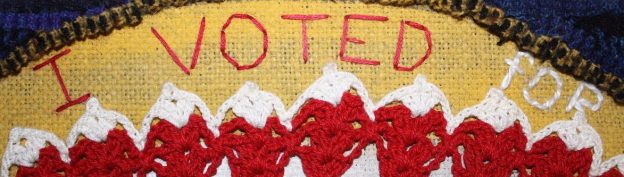
Ok the USA part was taken care of. Now the women I voted for and the message to VOTE. Using thin and thick lines with different contrast, I wanted to draw people into the piece from afar to find a secondary message.  The red thread for I VOTED, AND YOU? can be read from farther than the white pearl cotton embroidered on the gold saying: “for BEVERLY KEADLE, CHARLOTTE PRITT, HILLARY CLINTON, NATALIE TENNANT“.

Iconic VOTE, Susan L Feller 2016

Iconic VOTE, Susan L Feller 2016

The background is hooked using five different wools in deep blue/purples with the brighter turquoise showing how, as in the other two pieces, the directional hooking creates stripes . I selected a very dark value for my solemn mood, a purple caste as one more acknowledgement of suffragette colors and for he highest contrast with the white wide hooked letters.

I think this is a strong piece with interesting details and look forward to the upcoming years exercising my right to VOTE. The eighteen year old women who vote for the first time in 2020 will be doing so 100 years and 25 Presidential Elections after the first.

Grocery shopping for designs

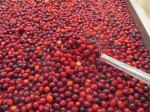
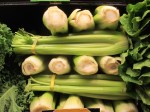
Anyone who knows us understands I shop for ingredients but don’t make the meals, that is Jim’s talent. So it is not unusual for me to take photos in the market. Here is my design study of Thanksgiving produce.

The cranberries in open vat intrigued me. Then how the celery were stacked reminded me of my wood pile. The orderly rows of round apples, random small cranberries, and unique shapes of squash are each examples of repeating patterns for design. I liked the long thin carrots bundled amidst the feathery greens, a more casual composition than the balanced celery.

vegetable designs

vegetable designs

Perhaps when shopping with your long list of ingredients for the holidays take a moment to observe pattern, shapes, color, even balance and design a memory piece.